
Jungle Against the Present
Jungle Against The Present
What its displacement from the dancefloor reveals about the limits of modern raving.
“Jungle was not designed for efficiency. It was designed for pressure.”
I haven’t been clubbing in a long time, at least not in a way that feels socially or culturally embedded, or in a way that resembles participation rather than consumption.
Part of that is structural. Across the UK, nightlife has become more expensive, more regulated, and more difficult to access without prior knowledge or social positioning. Nights out are no longer discovered so much as pre-selected, ticketed, and circulated in advance, with even so-called underground events operating within frameworks of scarcity and exclusivity that mirror the systems they once positioned themselves against.
As Sarah Thornton argued in Club Cultures, subcultural capital is tied to access, to who knows, who gets in, and who can afford to be there. What we are seeing now is not the disappearance of that logic but its intensification.
At the same time, part of this shift is positional. The social spaces I move through now feel further removed from the Black British cultural contexts that jungle emerged from, contexts rooted in sound system culture, pirate radio, and diasporic exchange. That distance reflects a broader restructuring of nightlife, including who it is for, how it is policed, and what kinds of sounds are allowed to take up space. So when asking what role jungle plays in modern raving, the question is not simply about genre relevance, but about whether the conditions that made jungle possible still exist.
“The night is no longer something to get lost in. It is something to be optimised.”
When thinking about contemporary club culture, it is difficult to ignore the influence of cities like Berlin, whose model of extended duration and immersion has become a reference point across Europe, but that model does not translate evenly.
In many UK cities, including London, Bristol, and Manchester, nightlife is shaped by compression. Licensing laws, transport systems, and economic pressure all enforce limits on how long a night can last and how it unfolds. Even events that aim for extended duration are structured around constraints that fundamentally shape the experience.
This is not incidental, but political. Legislation such as the Criminal Justice and Public Order Act 1994 and the Licensing Act 2003 continues to shape how events are organised and policed, while redevelopment, rising rents, and venue closures have reshaped nightlife infrastructure across the country. As Mark Fisher argued, capitalist realism produces a sense that even leisure must conform to systems of efficiency, surveillance, and monetisation. Music does not escape that pressure.
Jungle, as it developed in the early 1990s through labels like Reinforced Records and nights like AWOL, was not designed for this kind of environment. It emerged from a convergence of rave energy and sound system culture that extended beyond any single city, shaped by networks of DJs, MCs, pirate radio stations, and local scenes. That network mattered and it still does.
In Bristol, the lineage from dub and sound system culture runs through collectives like Young Echo, where low-end pressure and experimental approaches to rhythm continue to echo jungle’s foundational logic. In Manchester, nights such as Hit & Run have long maintained a space for break-driven intensity within a city more often associated with house and techno. In Leeds and across Yorkshire, free party networks and DIY soundsystem crews have sustained forms of rave culture that exist largely outside formal infrastructure. These are not nostalgic holdovers. They are continuities.
As Kodwo Eshun writes in More Brilliant than the Sun, Black electronic music operates as a form of sonic fiction that produces futures through sound. Jungle did this through acceleration, density, and rupture, intensifying rather than smoothing experience. It was not just music, but pressure, and that pressure was collective.
“You cannot passively consume jungle. It demands attention, or it loses you.”
The MC was not an accessory, the rewind was not a gimmick, and the crowd was not passive. Jungle functioned through interaction, whether in London warehouses, Bristol sound system sessions, or pirate radio broadcasts that cut across geography. To place jungle within contemporary club environments is therefore not a neutral act, but a process of translation that often results in reduction. The amen break is chaotic, and that is precisely the point.
Where much contemporary club music privileges repetition and control, jungle introduces rupture by destabilising rhythm and demanding attention in ways that resist background listening. You cannot half engage with jungle because it either pulls you in completely or loses you altogether.
This is where it clashes with many forms of modern raving culture, which increasingly function as spaces of circulation, where people move between rooms, document their presence, and engage socially alongside the music. Jungle interrupts that flow.
There has been a resurgence, with artists like Tim Reaper and labels such as Future Retro London bringing jungle back into visibility, while breakbeat-driven forms have re-emerged across lineups. But visibility is not the same as context.
“What we are seeing is not a revival, but a translation.”
What is often presented is a version of jungle that fits contemporary formats, where sets are shorter, production is cleaner, and the role of the MC is reduced, while sound system culture becomes secondary to venue infrastructure. This is not necessarily inauthentic, but it is partial.
Certain venues, particularly in London, exemplify a dominant model of contemporary nightlife that is industrial, minimalist, and internationally legible. These spaces are highly effective at delivering sounds that translate easily across borders.
Jungle does not translate so easily. Its sonic language is tied to specific histories, including migration, pirate radio, and the material conditions of 1990s Britain, meaning that it does not detach from those contexts without losing something essential. As a result, when jungle appears in these environments, it often does so as a fragment rather than a foundation.
To say that jungle is no longer cool therefore misses the point. Coolness, as Thornton makes clear, is relational, depending on systems of visibility and validation. Jungle has not disappeared because it is no longer cool, but has instead been displaced as the systems that once supported it have been eroded.
It persists in smaller venues, in community-led events, and in sound system sessions across multiple cities, where bass weight and collective experience remain central. It exists in digital continuations of pirate radio and in localised scenes that operate outside mainstream recognition. In these contexts, jungle is not a revival but a continuity.
“Jungle has not disappeared. It has been pushed to the edges.”
What has changed is the infrastructure. Gentrification, policing, and economic pressure have reshaped nightlife across the UK, producing environments that are more curated, more exclusive, and more controlled. Jungle does not sit comfortably within that environment. It is too fast, too dense, and too historically specific to be easily repackaged as ambience or lifestyle, that resistance matters. The role of jungle in modern raving is not to dominate, nor to recreate a past that cannot be reproduced, but instead to expose the limits of the present.
“Jungle does not fit modern raving culture. That discomfort is the point.”
It reminds us that raving once allowed for intensity, collectivity, and unpredictability in ways that are now increasingly difficult to sustain.
Jungle does not fit comfortably within modern raving culture, and that discomfort is precisely the point, marking the distance between what raving has become and what it once was, while suggesting that something meaningful has been lost in the process.
written for Junglist Network by Billie Monnier-Stokes
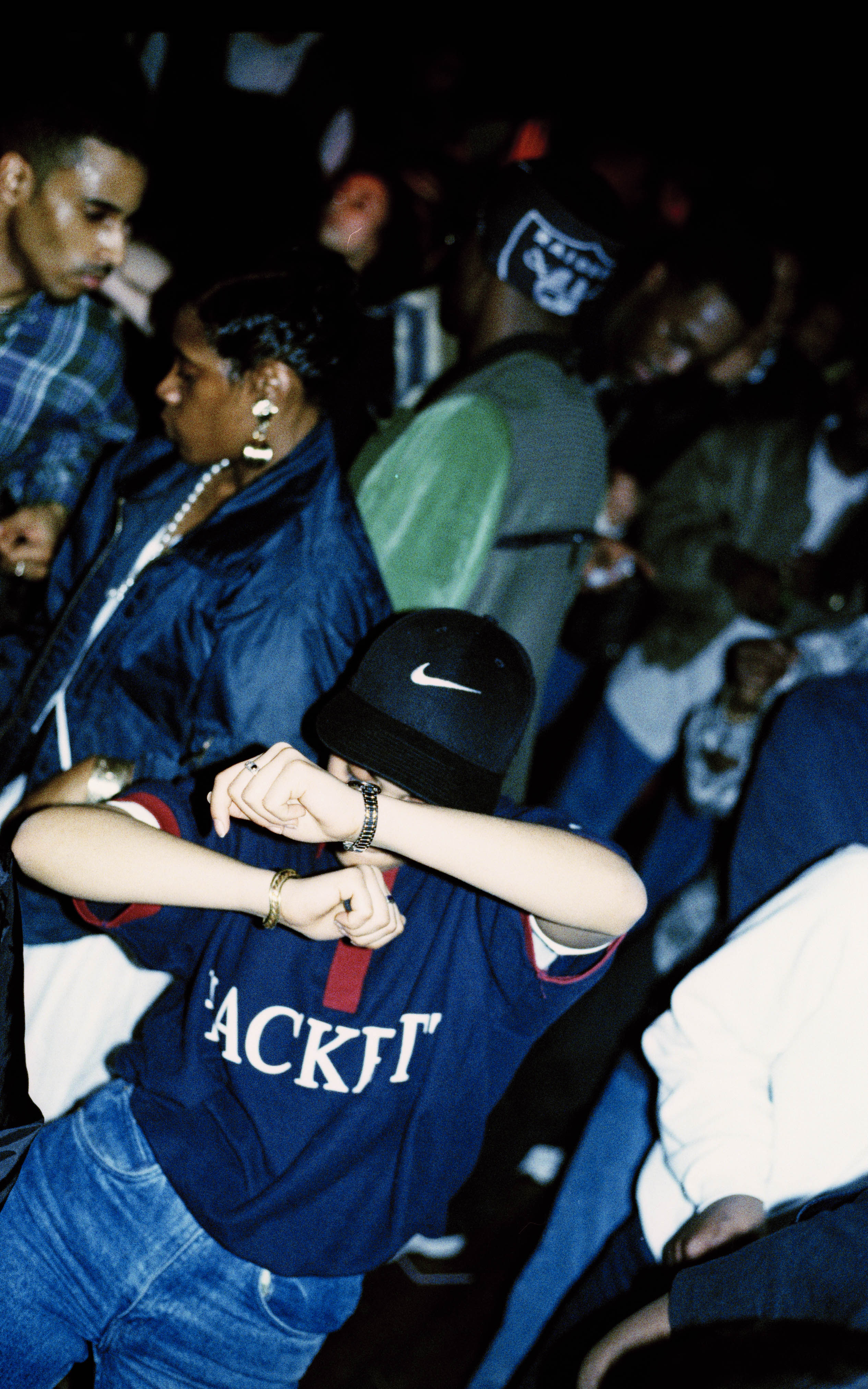
Photograph by Eddie Otchere of Roast at the Astoria