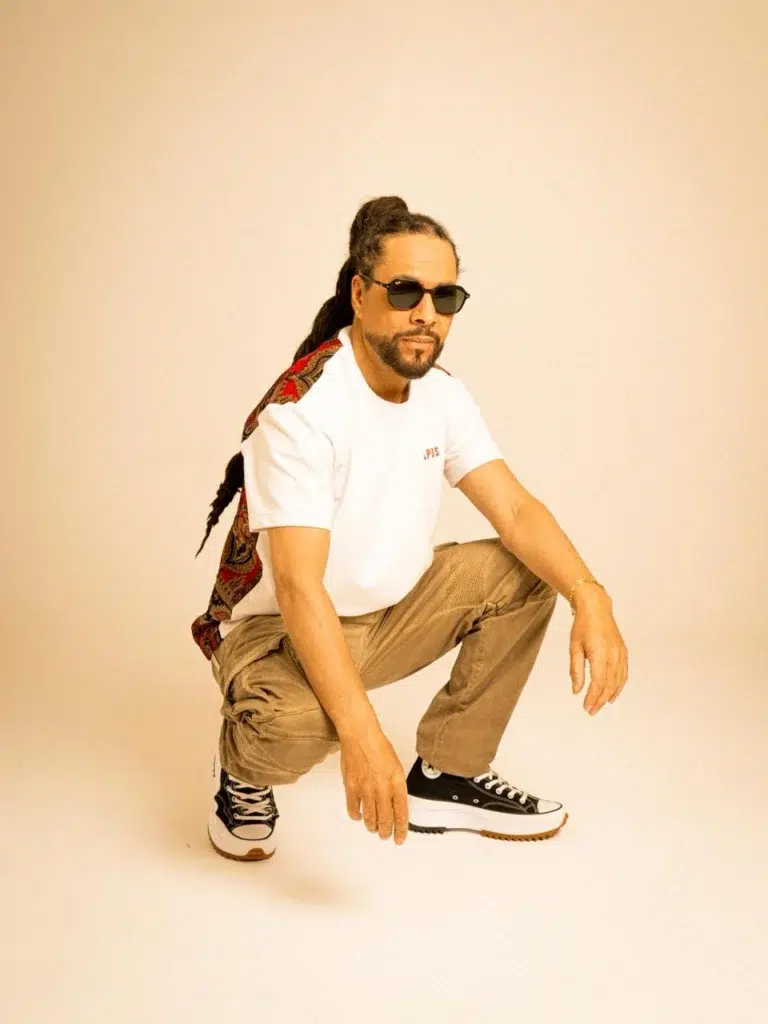

Roni Size
Roni Size is one of the most genre defining figures to emerge from Bristol’s contribution to jungle and drum & bass. A producer, DJ, label founder and bandleader, he helped develop a distinctly Bristolian approach to the music, one where heavyweight breaks and basslines could coexist with hip hop, reggae, jazz, soul and live instrumentation. His influence stretches from the early days of hardcore and jungle through to the international success of Reprazent and the continuing evolution of drum & bass.
Born Ryan Owen Granville Williams in Bristol in 1969, Size grew up surrounded by the city’s soundsystem culture. His musical education came as much from the streets and local community as it did from records, with reggae, dub and hip hop providing an early foundation. Bristol’s emerging rave scene then opened the door to breakbeat hardcore, giving him a musical language that he would spend the next three decades continually reshaping.
Before becoming an internationally recognised name, Size was involved in youth work and music production in Bristol. A home studio gave him the opportunity to experiment with dub, hip hop and breakbeats, while his involvement with local soundsystems brought him into contact with other young producers who were trying to make sense of the rapidly changing rave landscape.
Among those producers were Kirk Thompson, better known as DJ Krust, Dave Jones aka DJ Die, and Suv. Their shared interest in breakbeats and the emerging jungle sound eventually became the foundation of one of the most influential production collectives in British drum & bass.
The answer to the problem of getting their music heard was simple: build their own infrastructure.
By the early 1990s, Size and his Bristol collaborators had established Full Cycle Records, alongside the related Dope Dragon imprint. The labels became vehicles for releasing their own music and creating an environment where their increasingly distinctive productions didn’t have to conform to the expectations of established record companies.
Full Cycle quickly became synonymous with the Bristol sound. It wasn’t a rigid genre formula, but there were recurring characteristics: rolling breakbeats, deep bass, unusual percussion, soulful musicality and a strong connection to reggae and hip hop. The music was often darker and more spacious than the frantic hardcore that had preceded it, but it retained the physical impact of the rave.
A crucial breakthrough came through Bryan Gee, who heard early Bristol material and became an important supporter of the group. When Gee and Jumpin Jack Frost established V Recordings, Roni Size and DJ Die supplied the label with ‘Agility’, which became V Recordings’ second release after Krust’s Deceivers EP. The connection between Bristol and V would prove enormously important to the development of drum & bass.
Size’s reputation grew rapidly. Working both alone and with his Bristol collaborators, he developed a catalogue that could move from stripped-back dancefloor pressure to more experimental and musical territory.
Tracks such as ‘Timestretch’ and ‘It’s a Jazz Thing’ became important early examples of his approach. The records retained the raw mechanics of jungle while introducing funkier rhythms, jazz-influenced musical ideas and a more spacious production aesthetic. They helped establish Size as a producer who was interested in what happened when the rules of jungle were deliberately bent.
This became the defining feature of his career.
Rather than seeing jungle as a fixed sound, Size treated it as a starting point. Breakbeats could be manipulated like hip hop drums. Bass could take inspiration from dub. Live instruments could be incorporated into electronic arrangements. Jazz harmony could sit alongside rave percussion.
The result was music that felt unmistakably connected to the underground but increasingly difficult to describe using conventional genre boundaries.
By the middle of the 1990s, Size and his Bristol crew were becoming major players in the international drum & bass movement. Full Cycle and Dope Dragon were releasing music from Size, Krust, Die, Suv and their various collaborative aliases, creating a catalogue that became highly prized by DJs and collectors. The labels’ output helped establish Bristol as one of the most important centres of British drum & bass outside London.
But Size had an even bigger idea.
He wanted to find out whether drum & bass could work as a live musical experience.
That idea eventually became Roni Size & Reprazent.
Formed in Bristol in the mid-1990s, Reprazent brought together Size with a changing group of producers, musicians and vocalists. The live configuration included figures such as Krust, DJ Die, Suv, Dynamite MC, Onallee and drummer Clive Deamer, among others. Instead of simply recreating DJ sets onstage, the project incorporated live drums, bass and vocals into the rhythmic framework of drum & bass.
The concept was radical at the time.
Drum & bass had largely been defined by DJs, MCs, samplers and studio production. Size wanted to demonstrate that the music could be performed by a band while retaining the speed, energy and low-end pressure of a club system.
That experiment produced ** New Forms **.
Released in 1997 through Gilles Peterson’s Talkin’ Loud label, the album became one of the most important records in the history of British electronic music. Tracks such as ‘Brown Paper Bag’, ‘Share The Fall’, ‘Heroes’ and ‘Watching Windows’ demonstrated how far the sound had evolved from the early jungle experiments of just a few years earlier.
The album was also a commercial success. New Forms reached number eight on the UK Albums Chart and remained in the chart for 46 weeks.
Then came the moment that changed the perception of drum & bass forever.
In September 1997, Roni Size & Reprazent won the Mercury Music Prize for New Forms.
The victory was significant not simply because a drum & bass album had won a prestigious British music award, but because it demonstrated that a sound born from pirate radio, illegal raves and underground club culture could command serious attention at the highest levels of the British music industry.
For Size, however, the Mercury Prize wasn’t the beginning of his story. It was the result of years spent developing a completely independent musical infrastructure in Bristol.
The success of New Forms also produced one of the biggest drum & bass singles of the era.
‘Brown Paper Bag’, with its instantly recognisable double-bass line, crisp breakbeats and jazz-inflected arrangement, became a crossover record without abandoning the musical ideas that had made Size’s earlier productions so distinctive. It reached number 20 in the UK Singles Chart, while other Reprazent singles including ‘Share The Fall’, ‘Heroes’ and ‘Watching Windows’ also reached the Top 40.
The achievement was extraordinary when placed in context. Just a few years earlier, jungle had been largely ignored by the mainstream music industry. Now a Bristol drum & bass collective was selling records internationally and winning the UK’s most prestigious album prize.
Size could have simply repeated the formula.
He didn’t.
The next Reprazent album, ** In the Mode **, arrived in 2000 and pushed further into hip hop, soul, jazz and experimental electronic music. The album featured collaborations with major international artists including Method Man, Rahzel and Zack de la Rocha of Rage Against the Machine.
It also produced another substantial UK chart run. In the Mode reached number 15 on the UK Albums Chart, while singles including ‘Who Told You’ and ‘Dirty Beats’ entered the UK Top 40.
Alongside Reprazent, Size continued developing his solo career. His 2002 album ** Touching Down ** explored a broader range of hip hop, soul and electronic influences, while retaining the breakbeat foundation that had defined his work. The album reached number 72 on the UK Albums Chart and number nine on the Independent Albums Chart.
The following years produced further solo projects including ** Return to V ** in 2004. The title itself was a nod to his long-standing relationship with V Recordings and the Bristol-London connection that had helped establish his career during the formative years of jungle. The album reached number 18 on the UK Independent Albums Chart.
Size also remained deeply connected to the underground. Despite the international success of Reprazent, Full Cycle continued to represent the Bristol approach to drum & bass, and Size regularly returned to DJing, radio and label projects.
The history of Full Cycle is particularly important to understanding his legacy. The label wasn’t simply a business venture; it was an attempt to create an environment where producers could develop their own musical identities without being forced into whatever style happened to be commercially successful.
That philosophy has continued into the modern era.
Full Cycle was revived by Size and Krust in the 2010s, with the pair revisiting unreleased material and eventually presenting new projects under the Full Cycle banner. Their return demonstrated that the label’s musical identity had not disappeared, it had simply been waiting for the right moment to return.
Size has also continued to explore new technology and new production methods. His later solo releases have included projects such as ** Take Kontrol ** in 2014, while subsequent singles and releases have shown that his interest in drum & bass remains firmly focused on evolution rather than simply recreating the past.
More recently, his catalogue has continued to receive attention from new generations of producers and DJs. In 2026, the Full Cycle Records platform remains active, carrying the Bristol legacy forward through archival material, mixes and new activity, while Size continues to perform and release music.
His influence can also be measured through the artists around him. Krust, DJ Die and Suv all developed major careers of their own, while the wider Full Cycle network helped establish a generation of Bristol producers whose music would influence drum & bass for decades.
But perhaps the biggest legacy of Roni Size is the idea that drum & bass could be anything..
That freedom was central to the Bristol sound and central to Size’s own career. He never treated the boundaries of jungle as limitations. Instead, he treated them as something to be tested.
More than three decades after his earliest productions, Roni Size remains one of the artists most responsible for taking British drum & bass from the margins of rave culture into the international spotlight. He helped build Full Cycle, helped establish the Bristol sound, reinvented the possibilities of live drum & bass with Reprazent and produced records that remain fundamental listening for anyone interested in the genre’s history.
And unlike many artists whose greatest achievements are firmly rooted in one period, Size has continued to push forward.
Essential Tracks & Releases:
🎧 Roni Size – Timestretch
🎧 Roni Size – It’s a Jazz Thing
🎧 Roni Size & DJ Die – Agility
🎧 Roni Size / Reprazent – Share The Fall
🎧 Roni Size / Reprazent – Brown Paper Bag
🎧 Roni Size / Reprazent – Watching Windows
🎧 Roni Size / Reprazent – Heroes
🎧 Roni Size / Reprazent – New Forms
🎧 Roni Size / Reprazent – In The Mode
🎧 Roni Size – Touching Down
🎧 Roni Size – Return To V
Bristol roots. Jazz-infused breaks. Bass culture. Roni Size didn’t simply help define the Bristol sound, he showed the world that jungle and drum & bass could become a complete musical language, capable of moving from the underground to the biggest stages without losing its soul.